
A Tale of Two Houses
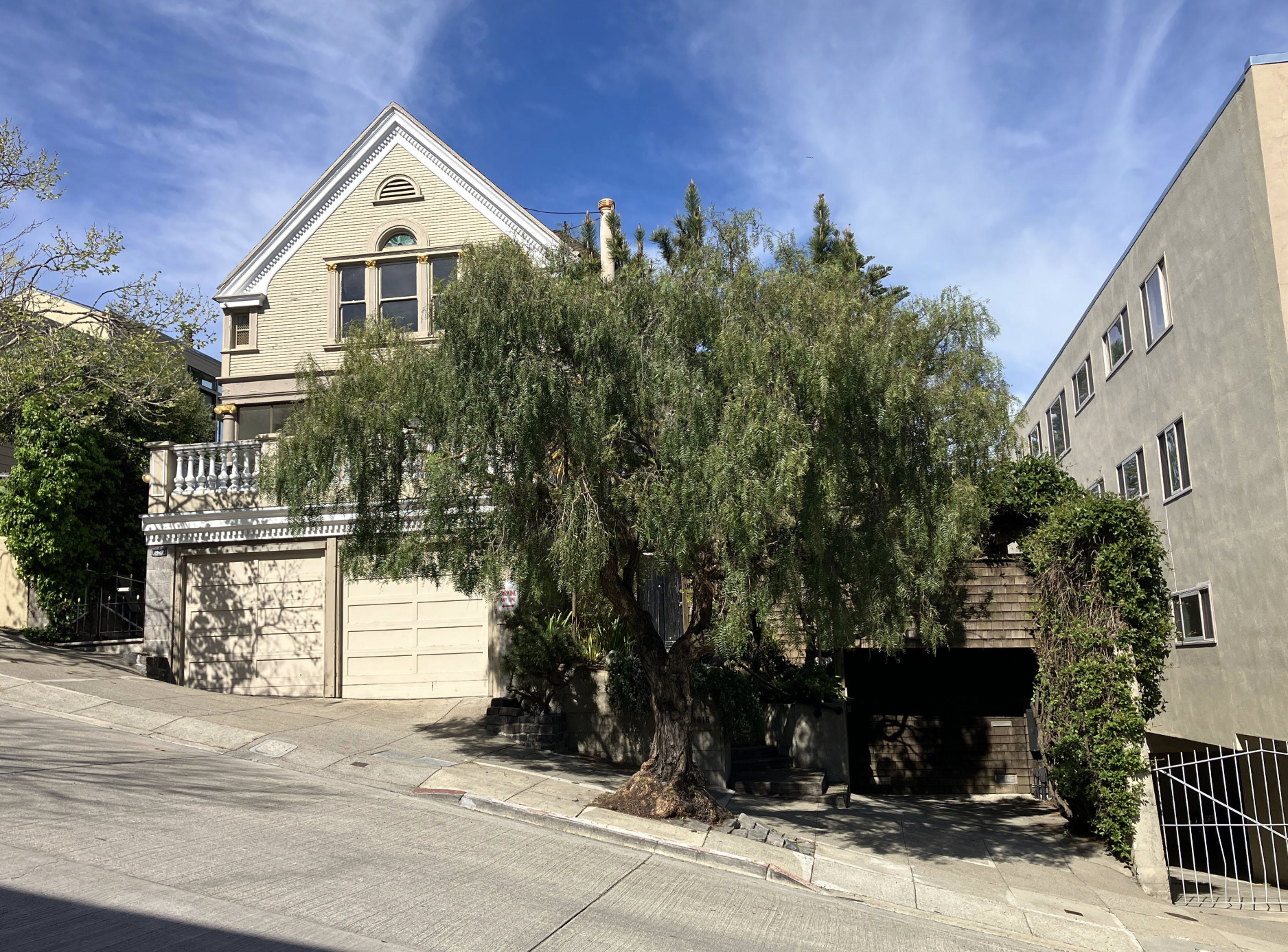
The two houses in Dolores Heights. The mid-century home is on the right, nondescript from the street in characteristic modernist fashion.
A couple of months ago I held open a couple of open houses in San Francisco’s Dolores Heights neighborhood. Dolores Heights is one of San Francisco’s sought-after prestige neighborhoods, located between Noe Valley, Mission Dolores, and the Castro, and steps away from Dolores Park. One house was a lovely 1,862 square foot gable-front Edwardian built in 1909, the other a cool-as-can be 1,902 square foot architect-designed mid-century modern home built in 1968. The Edwardian needed a bit of work but was overall a beautiful home; the mid-century home was an exquisite and unspoiled gem, ready for an appreciate new owner.
I was warned beforehand that these open houses would be busy, but this was something else entirely. Over the weekend and twilight tours I held both homes open, and both had a steady stream of people from start to finish. People were waiting outside before the open houses, and lingered long after the advertised closing time.
Each home ended up having multiple offers. This was not surprising, given the limited number of listings in San Francisco compared to demand. But what was surprising was the amount the homes ended up selling for. The 1909 Edwardian was listed for $1,988,000, and sold for $3,300,000 (66% over asking). And the mid-century modern home? Listed for $2,188,000 and sold for $4,225,888 (a whopping 93.1% over asking).
So what gives? One thing needs to be noted, that in a highly competitive sellers’ market like San Francisco, many listings utilize the “list low to go high” strategy, with a list price that’s clearly below market. While this can be frustrating to buyers, it represents that the market is in flux and values are a function of demand. A house is worth as much as people are willing and able to pay. In this sense, setting the listing price low is not unlike an auction with an opening bid – everyone expects the price to rise from the opening bid, but how much it rises is anyone’s guess.
The other thing is that these are houses, and houses have been commanding a premium since the pandemic. Granted, in San Francisco a “house” might be built wall-to-wall with the next door neighbors, but it has its own lot and is structurally independent. During the pandemic, the preference for houses over condominiums became really pronounced, and that preference has stuck. The gulf between condos and houses has never been greater, as far as I can tell. (Which means condos can be really good values, but that’s for another article…)
The two homes in Dolores Heights represent a trend in San Francisco that has really taken off since the beginning of this year, confirmed in a recent San Francisco Business Times article. The bidding wars are back, and not in some mild, transitional way. They are back in full force. It cited an example in the Richmond District that listed for just under $3 million and sold for nearly $5 million – almost $2 million over asking. The same pattern is showing up in the Inner Sunset, Noe Valley, Diamond Heights. One million over asking. One and a half. Two. Again and again.
At a certain point, you stop calling it surprising, and you start asking why.
The easy answer is the one we always fall back on. This is San Francisco. High incomes, limited supply, competitive buyers. Of course homes sell over asking.
But that explanation feels incomplete right now.
What I see in this moment is something more specific. Buyers are not just competing for homes. They are competing to avoid the alternative, which would be a construction project. The homes selling for the most over asking are fixed up and ready to go. The idea of buying a fixer and turning it into your ideal home used to be part of the appeal of this market. But now, with construction costs, permitting processes, and uncertain timelines, it feels more like a gamble.
So buyers are making a different calculation. Pay a premium for something that is already done, or take on a process that is expensive, unpredictable, and slow. More and more, they are choosing to pay.
The Business Times article talks about the prevalence of all-cash offers, but what stood out to me is how those offers are being assembled. Buyers are not always sitting on cash. They are creating it. Leveraging portfolios, tapping retirement accounts, taking margin loans, doing whatever it takes to present a clean, no-contingency offer.
From the seller’s side, it is hard to say no to that. There’s no risk of the house not appraising, and no financing issues. A quick, certain close. These cash deals are closing in just a matter of days, not weeks.
The numbers reinforce the story. Median home prices are pushing toward $2 million. A majority of homes are selling above asking. Overbidding rates are climbing back toward peak levels. Meanwhile, the national market is basically flat, and California overall has seen slight declines.
San Francisco is doing what it often does. It is breaking away from the broader trend.
And that brings me to the part that is harder to ignore.
I do not think this is just a hot market story. I think it is a systems story.
We have created a situation where it is incredibly difficult to add to or improve the housing stock in a predictable way. When that happens, the market does what it always does. It concentrates demand on the limited number of homes that avoid that process entirely.
Those homes become scarce. Then they become competitive. Then they become expensive in a way that starts to feel disconnected, until you look closer and realize it is not disconnected at all. It is the logical outcome.
I’ve written in other posts about how San Francisco is coming back, and that’s exciting. But with that comeback comes increased demand. The demand is amplifies for houses, and further amplified for houses that are fixed up and move-in ready.
Putting on my city planning hat, we lack is a system that can translate that demand into actual housing in a way that is timely, predictable, and scalable. The problem isn’t that not enough housing is being approved since there are literally thousands of approved units in San Francisco and the Bay Area eligible and waiting to be built. The problems are construction costs, availability of construction financing (or lack of), and difficult construction logistics extending from permitting through utility connections. We do not have a demand problem, we have a delivery problem. Until that changes, moments like this are not aberrations. They are the logical outcome.
And if you are a buyer looking to purchase in San Francisco or the Bay Area, allow me to show you some great condos and lofts. There’s still value to be had there, but prices there will catch up too before long if more new units don’t come onto the market.